GeoVoxels
Now in Beta

Solving the Data Bottleneck for Subsurface AI

Load existing geological models, restore them to identify faults and folding effects, then generate millions of stochastic realisations — the synthetic training data that enables deep learning for the subsurface.

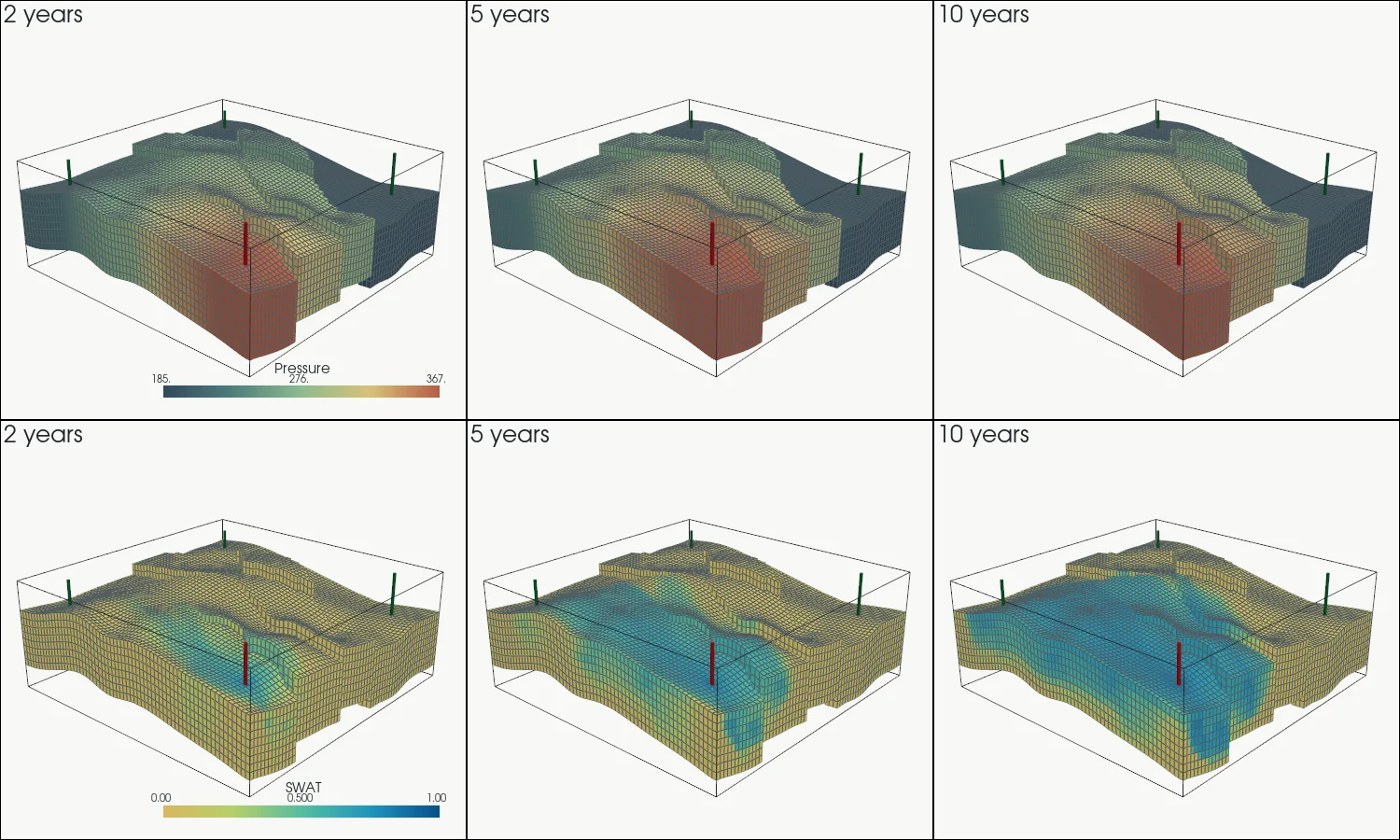
GeoVoxels geological model visualisation — example 1 of 4GeoVoxels geological model visualisation — example 2 of 4GeoVoxels geological model visualisation — example 3 of 4GeoVoxels geological model visualisation — example 4 of 4
How It Works

From Model to Trained AI

01

Load & Restore

Load existing reservoir models and perform geological restoration to identify faults and folding effects.

02

Generate Realisations

Stochastically produce millions of geologically valid 3D model variants with full structural uncertainty.

03

Build Training Dataset

Export labelled geological models in industry-standard formats, ready to feed into deep learning pipelines.

04

Train & Benchmark AI

Train deep learning architectures on your synthetic data. Compare model performance on standardised benchmarks.

Products

The Tools Behind the Data

Generate new geological models with GeoSketch, or load and restore existing ones with GeoEdit to identify faults and folding effects. Stochastically perturb the parameterised models to generate large training datasets. Then train and benchmark deep learning architectures with ProxySim.

Capabilities

What Makes This Possible

A restoration engine, a structural editing toolkit, and benchmarked deep learning — combined into one platform.

Stochastic Generation at Scale

Generate millions of geologically valid model realisations from a single template. Each realisation captures structural uncertainty in faults, folds, and surfaces.

Restoration & Structural Identification

Load reservoir models and perform geological restoration to automatically identify faults, folds, and other structural elements — enabling targeted editing and perturbation.

Model Import & Standard Formats

Load models from industry-standard formats like GRDECL. Export generated realisations back to the same formats for use in Eclipse, CMG, or any reservoir simulator.

Deep Learning Benchmarks

Multiple DL architectures trained on a large synthetic geological dataset. Benchmarked and compared so you can pick the right model for your problem.

Built for Production

No installs. Standard formats. Real-time feedback.

Industry-Standard Export

Output to GRDECL and other formats. Drop into Eclipse, CMG, or any reservoir simulator.

Browser-Based, Zero Install

Open a tab and start modelling. No software installs, no IT tickets.

Real-Time 3D Visualisation

See your model update live. Slice, rotate, display properties — all interactive in the browser.

Use Cases

Built for Multiple Workflows

Whether you need training data, uncertainty analysis, or rapid geological prototyping — the same generative engine powers all of it.

AI Training Data Generation

Create large, labelled synthetic geological datasets for training deep learning models. The data bottleneck for subsurface AI — solved.

Structural Uncertainty Quantification

Explore how changes in fault positions, fold geometries, and surface shapes affect your model. Quantify what parameters alone cannot.

History Matching

Incorporate structural uncertainties into your history matching workflow. Match history to geology, not just parameters.

Rapid Model Exploration

Load a model, restore it, and iterate on structural alternatives. Explore what-if scenarios for faults and folds in seconds.

About Us

Building the Future of Subsurface AI

GeoVoxels is developing tools to solve the data bottleneck holding back AI in reservoir simulation. Our platform combines geological modelling expertise with deep learning research to generate the synthetic training data that subsurface AI needs.

We believe that high-quality synthetic geological data is the key to unlocking accurate, fast, and scalable AI models for the energy industry. Our tools enable researchers and engineers to generate millions of geologically valid model realisations — bridging the gap between limited real-world data and the data-hungry requirements of modern deep learning.

Contact Us

Get in Touch

Interested in early access or have questions about our tools? We'd love to hear from you.