CO2 Nested
3D CO2 storage benchmark on a nested 100x100x5 grid with 24 prediction timesteps. Models predict pressure change from permeability, porosity, and injection parameters.
Nested-grid pressure case study
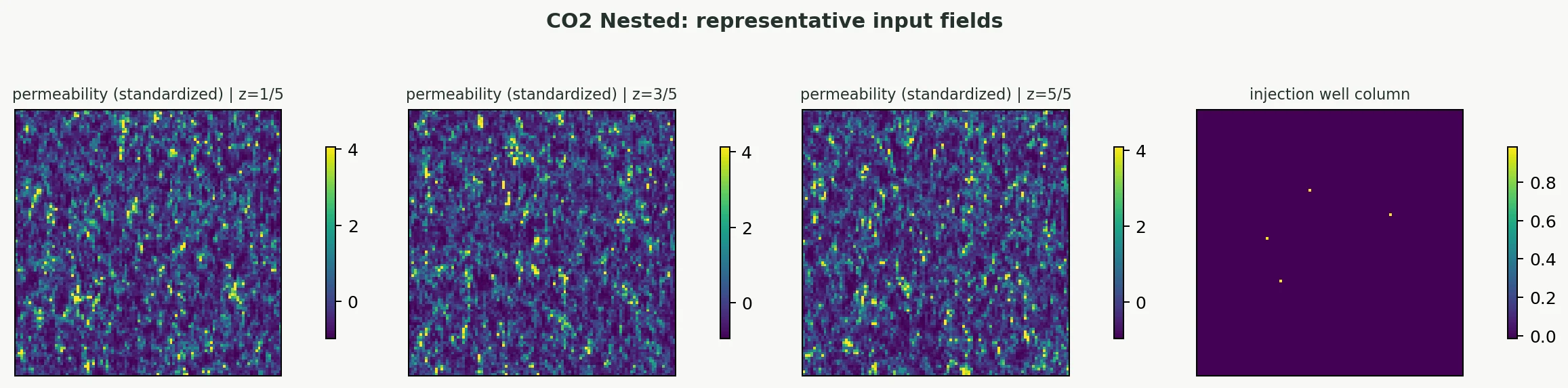
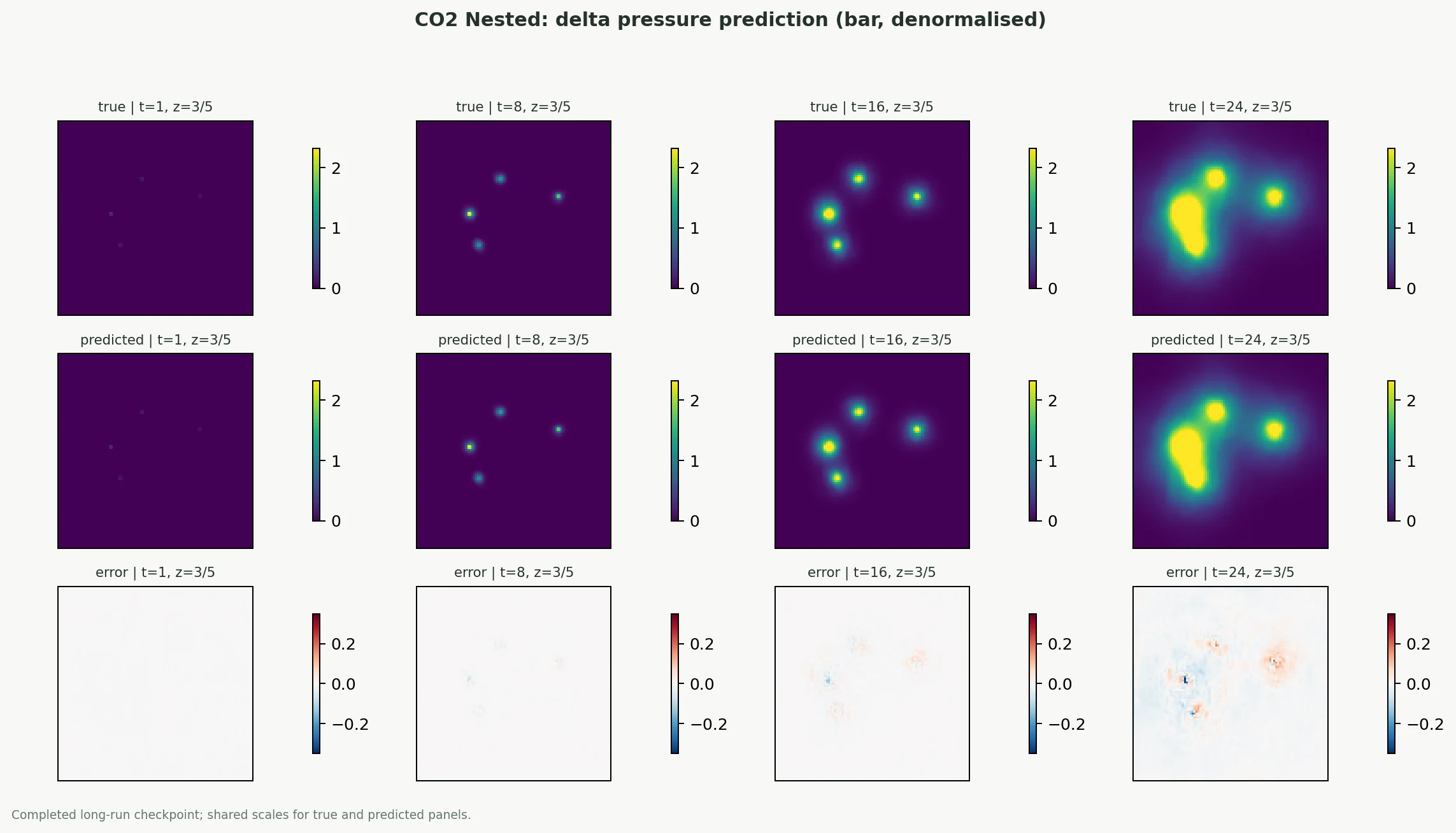
Static figures from a completed long-run. The panels show the model input context, including initial-state fields, plus the true pressure buildup, the prediction, and the signed error at selected timesteps for a held-out case.
Representative held-out case
Leaderboard
Metrics Over Time
Target variant: default.
DELTA_PRESSURE
Paper Metrics Comparison
Metrics from the shared paper-metric module (utils/paper_metrics.py) evaluated on the held-out test split. Loss column distinguishes the training recipe; lower is better.
| # | Model | Loss | Epochs | delta_p▲ | pressure_mre_t1 | pressure_mre_t2 | pressure_mre_pinit |
|---|---|---|---|---|---|---|---|
| 1 | UNet3D | RelLp | 800 | 0.0002 | 0.0223 | 0.0167 | 0.0008 |
| 2 | UNet3D | RelLp | 500 | 0.0002 | 0.0238 | 0.0177 | 0.0008 |
| 3 | UNet3D | RelLp | 200 | 0.0004 | 0.0401 | 0.0283 | 0.0013 |
| 4 | SegResNet | RelLp | 200 | 0.0005 | 0.0500 | 0.0356 | 0.0016 |
| 5 | FNO3D | RelLp | 200 | 0.0023 | 0.2339 | 0.1813 | 0.0084 |
About This Benchmark
This benchmark extends the CO2 storage modeling work of Wen et al. (2023) to a 3D domain using nested local grid refinement (LGR). The simulation domain is a 100x100x5 grid representing a deep saline aquifer with CO2 injection, where the nested mesh provides higher resolution near the injection well and coarser cells in the far field.
The nested grid approach is commonly used in industrial reservoir simulation to balance accuracy near wells (where pressure and saturation gradients are steepest) with computational efficiency in the far field. This makes the dataset a practical test of whether surrogate reservoir simulation models can handle non-uniform spatial resolution — a common challenge in real-world subsurface modeling.
Each simulation produces 24 timesteps of delta pressure (pressure change from the initial hydrostatic state). The target variable is specifically the pressure perturbation rather than absolute pressure, which is the physically meaningful quantity for assessing storage integrity and induced seismicity risk.
Input features include permeability, porosity, and well parameters that define the injection scenario. The 3D nature of the domain with only 5 layers in the vertical direction presents a challenge for architectures that require input dimensions divisible by large powers of 2.
Note: Swin UNETR is excluded from this benchmark because MONAI's implementation requires all spatial dimensions to be divisible by 32 (due to the shifted window attention mechanism), which is incompatible with the depth dimension of 5.
Input features
Paper metrics explained
Training Configuration
Configuration for the best-performing model (UNet3D).